Monday, April 17, 2006

Link Traps

Sometimes we get so caught up looking for the latest and greatest link building program we forget about the simple, tried and true tactics that attract links. Before you invest time and money on a linking program, take care of business at home by creating some of these easy but effective link traps…

You Have To Tell Them What To Do.

Do you have a “link to us” page? If you don’t, consider adding one and include a link to it from all the content portions of your site. People are more likely to link to content they like right after they’ve read it, especially if you’ve told them it’s ok to use the content and show them how. Create a page with varied linking options such as:

Multiple text links with varied anchors and URL’s
Tagged images
Sections of re-printable content with links embedded

The last option is most desirable IMO and probably the most attractive to the blogging and media community. I’ve found journalists and bloggers resist being asked to write something or reprinting press releases in whole but will copy and paste sections of relevant information in addition to links. To have it ready and available makes their lives easier and increases your chances of having your link-embedded copy used.

Offer Them Something. (Link Incentives Work!)

For the most part, people need an incentive to link unless your site is exceptional, well known or the latest craze. Sweeten the offer by giving away something of value in exchange for the link. My friend Randy Cullom ('Randy' on the High Rankings forum) does a great job with this, take a look at what he's done:
Webmasters: Link to us and receive a free one-year subscription

His offer is clear, well written and of value to people interested in certificates.

Give Them A Little Trust Nudge.

When’s the last time you ordered something from LLBean? After you took out your new parka, did you notice the extra catalogs in the bottom of the delivery box? They throw them in hoping you’ll spring for matching ear flaps or pass the catalogs on to someone else in the neighborhood. Basically, they're giving you an easy way to find and order more stuff. What if you did something similar and included link instructions to your product pages in every -

Email
Auto-responder
Correspondence and
Product delivery box/file?

Chances are people will add the link or tag (think Slashdot / Del.icio.us / Digg ) your pages to let others know about the great services you offer.

I’ve talked about trust links before but their importance bears another mention here. If someone takes the time to ask for more info or makes a purchase from your site, they’ve shown interest and/or trust in your products. While they’re basking in that warm fuzzy afterglow, offer information on how they can link to your site or link to relevant information within your site.

I know adding a “link to us” page isn’t as exciting as creating a snazzy link bait program or rewriting follow-up correspondence isn’t as sexy as developing an uber tool – but – they’re both solid tactics that work with minimal effort.

Before you implement the gee-whiz linking schemes to support revenue and link producing initiatives like product announcements, endorsements and/or other news worthy items, get your house in order. Then sit back and listen for the cha-chink of the link traps!

Keywords: link incentives, link tags, link to us, link bait

Slashdot / Del.icio.us / Digg

Thursday, April 13, 2006

Yes, I get by with a little help with a little help from my friends....

You know how you always remember your first time .........

Being interviewed that is ! Well, Peter Da Vanzo was my first, he popped up one day and said "hey Debra, do you have five mintues and can I interview you for my blog?" That five minutes turned into two weeks of chatting and we've been friends ever since. When I pinged for something to add here, he responded with what you'll read below. Typical of Peter, he's always helping a friend - or two! :)

The 3-Page Search Engine Optimisation Technique by Ammon Johns

Performing basic optimisation to improve the rankings of a page in search results is not truly that difficult. Generic search engine friendly optimisation techniques work well in most engines. When competition is fiercer, and many of your competitors have some level of search engine optimisation too, things become harder.

At this point, the content needs to be better optimised for the particular algorithm than the competitors' content is - and this means choosing which algorithm (and search engine) you will attempt to match. One page cannot closely match different algorithms, and each of the major search engines has its own algorithm.

Can a single optimised page match (at more than a generic level) with both the Google algorithms (providing the search results at Google, Yahoo and AOL) and with the algorithms of Inktomi (providing the bulk of search results at MSN)?
The answer is 'No'...... (click for the rest of the article, it's a tad long but worth the read)

Peter Da Vanzo, is a search marketing strategist and industry commentator based in Wellington, New Zealand. He's the owner of SearchEngineBlog (circa 2002) which examines the search world from a grassroots perspective. He can also be easily bribed with beer.

Monday, April 10, 2006

DNS Issue

I've been a member of SEOConsultants for several years and have always been impressed with the way Edward runs the show over there. So when he sends email and asks folks to post about an issue he feels important -- I'm happy to do it. From Edward:

DNS Recursion is DNS Cache Poisoning

This issue has now escalated to a much higher level as we have some topics going on at WebmasterWorld that have discovered particular instances of DNS Cache Poisoning and how it is affecting those involved.

As a search marketer, it is your responsibility to understand at least the basics of what is happening so that you can report your findings to those reponsible for your DNS, Web Hosting, Email, etc.

Please, this is a very serious issue and we hope that those of you with Blogs, Forums, etc. will help get the word out there so that the server administrators of this world can help close the gap that shows 75% of DNS Servers are open for recursion. That is a scary thought!

http://www.seoconsultants.com/tools/dns/cache/

Friday, April 07, 2006

Elephant Links

Remember this from your Marketing 101 class?

If the circus is coming to town and you paint a sign saying ‘Circus Coming
to the Fairground Saturday’, that’s advertising.

If you put the sign on the back of an elephant and walk him into town, that’s promotion.

If the elephant walks through the mayor’s flowerbed, that’s publicity.

If you can get the mayor to laugh about it, that’s public relations.

And if you planned the elephant walk, that’s marketing.

Let’s change it up a bit for Link Marketing 101:
If you pay for a link on a high profile site, that’s advertising.

If that high profile link contains an exclusive special offer, that’s promotion.

If the exclusive link promotion is virally passed, that’s publicity.

If the viral promotion is blogged by many, that’s public relations.

And when your site suddenly becomes a three-ring traffic circus... that’s marketing.


Tuesday, March 28, 2006

Yes I get by with a little help from my friends with a little help from my friends...

If I had a dime for every minute I've spent laughing on IM with Scottie we'd ALL be able to retire early! We even hook up the webcams and let our kids chat with each other from time to time - it's a real family affair. Luckily, she's popped by and agreed to let me run this article on image links, -- thanks buddy.

Hmmm, wonder if Mr. French would be as good a friend and come clean my house? ;)

Image Links, SEO and Usability. How Image Links Can Help Build a Better User and Search Experience.
by Scottie Claiborne.

There are webmasters out there who believe that good design, usability, and SEO can't co-exist in the same site; that effective SEO will ruin usability or design elements. While there are plenty of examples that seem to prove this point, it doesn't have to be that way.

Ask for advice on building a search-friendly website, and one of the tips you will often receive is to use text links throughout your site. Text links are read by search engine spiders and render the same regardless of the type of browser being used. They are accessible by screen readers and can be easily identified as links using CSS rollover properties. It's great advice and you can't go wrong using text links.

However, sometimes the most relevant phrase for a page is just too long to use in your primary navigation without looking awkward or simply including too much information for the typical site user. That's when image links may be a better choice.

Image Links VS Text Links for SEO

Text that makes up a link is referred to as anchor text and it can be a powerful tool for search engine optimization. The text in the link tells the search engine what that page is about, and it is so powerful that pages can rank well for terms found only in links to the page and not on the page itself. (Type "miserable failure" into a Google search for an example.)

Customized text links are highly prized for their ability to improve rankings for specific search terms and it makes sense to use them on your internal pages, since those pages "count" when the engines look at links and relevance.

Image links are followed and counted as well, and the text in the alt attribute for the image serves the same function as anchor text. General theory holds that alt text isn't as "powerful" as link text, and for good reason. Webmasters who try to "game the system" stuff zillions of phrases into their image alts in an attempt to rank better for those terms. Because it isn't an element that is likely to be seen by users (unless they hover over an image), it can be more easily abused. In general, search engines prefer to give more weight to elements that users can see.

While it's difficult to prove that alt text on image links is "less important" than text links, it does seem to make sense that text links have a little more "weight" than image links.

The SEO Challenge

In an attempt to rank well for keyword phrases, you are likely to see sites that don't just link to
Home

now they link to:

Cincinnati OH Home Cleaning Services Home Page

Where

Carpet Cleaning
Duct Cleaning
Drapery Cleaning

were once enough, you now see links that say

Cincinnati OH Carpet Cleaning
Cincinnati OH Duct Cleaning
Cincinnati OH Drapery Cleaning

From an SEO standpoint, it's a pretty smart move. From a design and usability standpoint, it stinks. Users have to look at extra words in the links that are there to help them find the page, but are superfluous and annoying to someone already in the site.

Image Links Get the Job Done

The answer is to put those long, relevant, but awkward keyword phrases into the alt attribute of an image link. If your home page really is about "digital camera repair services", you can put that in the alt attribute of an image link that simply displays the word "home".

• Home- The page will be relevant for "home", which doesn't really benefit the page or help search engines to know what the page is about.

• Digital Camera Repair Services Home- The page will get extra relevance for Digital Camera Repair Services Home, but it looks awkward and may confuse users.

• Now, the users simply see a "home" link, which is easy to understand, but the search engines read "Digital Camera Repair Services Home Page" and assign that page a little more relevance for that term. Users who hover over the link and screen readers will still see a relevant explanation of what the link is about.

Image links can be used throughout the site for sites with awkward keyword phrases, or be used selectively for pages like "Home", "Contact Us", "About Us", and other key pages that are best identified with short phrases, but can be described better using an alt attribute such as "Contact the Digital Camera Repair Service Center".

It's Not a Question of "Better" or "Worse"

Text and image links both serve a function and you can build a site using exclusively one or the other, and it will be fine. However, when you consider the terms that you want to rank well with and the need to balance simplicity with specific words, image links offer an alternative to wordy text links that don't integrate into your navigation very well.

Getting a mild boost for your desired keyword phrase in an alt attribute is STILL better than getting "full" credit for "About Us". It just makes sense to use those internal links to help identify the full topic of the page. Just remember not to go overboard when adding your alt text- only use the phrase that best describes the page.

Scottie Claiborne is the Web Marketing Strategist for Right Click Web Consulting and the facilitator of the Successful Sites Newsletter. She is a speaker at the Search Engine Strategies conferences and the High Rankings Seminars as well as the Administrator of the High Rankings Forum.


Thursday, March 23, 2006

Saturday, March 18, 2006

Yes I get by with a little help from my friends with a little help from my friends...


Bill Nye might be the Science Guy but Bill Slawski is the SEO Patent Guy! He's also one of the nicest people you'd ever want to meet and a fellow member of the SMA-NA. He's stopped by and left us something "on the silly side of linking". Enjoy!


A morning walk, with hypertext

Funny where links are showing up these days offline, in the world. This morning, I decided to keep my eyes alert for hypertext on a stroll through the small town I live in.

Grabbing a cuppa joe at the big chain bread and coffee place near me, I notice that the receipt not only has a web address, but also instructions to provide feedback by web or toll-free phone number to be eligible to win a monthly $ 2,000. cash prize. Good to see calls to action with a link. That seems like a good idea.

I also pick up a copy of the local paper. Usually I read it online, but sometimes I like to relax with breakfast and the news, and it's hard to eat and type at the same time. Prominently under the paper's name is the online address. I wonder if subscriptions to the printing-press version has suffered, or if it appeals to a different demographic than the online edition.

The place where I pick up my paper is my local newstand, and I ask myself, as I look at the magazine covers, how many of them don't have websites. The newstand has been in business for years, and it's a local institution, serving folks a mix of books, magazines, papers, lottery tickets, snacks, and drinks. Lots of URLs all over the place, on almost everything they sell. Are newstands like this one an endangered species?

Walking through a parking lot, I feel an urge to click on cars, noticing that some Maryland and Pennsylvania license plates include URLs instead of state mottos. Kind of hard to mouse over vehicles while they are barreling down the highway, but it must help spread the word that these states have websites.

You never know when you might need a dumpster, but if you do, the garbage removers near me are savvy enough to include their URL on the big green trash receptacles I walk past this morning. I'm surprised at some of the places where I didn't see URLs, like the DHL pickup box, Verizon payphones, and a number of stores and restaurants that I know have web sites.

Some of the food places do have their URLs painted on their glass windows, or on signs. A couple have tent signs I have to walk around on the sidewalk, with their web addresses on them. One of those dining establishments holds special dinners celebrating different events, and I see they have a couple of signs touting a “Graduation Day Special Dinner.” (I like living in a college town.) The signs state that this is “reservation only,” and they let people know that they can make those reservations online, listing the address.

A few other places using the internet as part of their front facade marketing include the local post office, one of the town's florists (who also has the URL on the back of the delivery van parked in front of the building), and one of the real estate agents, with a sign in the otherwise empty window of a store that closed a couple of months ago.

I see a few nods to online guerilla marketing, with events listed on a community bulletin board with web sites noted, and a sticker for a clothing store placed graffiti-like on a oneway sign in an alley. Another sticker for a band, with URL, is seen a little further down the street. I don't know if this is a good idea, or a bad one, but I did write the band's name and address down.

Returning with a hot coffee and chocolate pastry (breakfast of champs), I see that the mailman has brought me some correspondence from around the world. The lowcost insurance company sending me mail displays their dot com in the return address instead of street, city, state and zipcode. I guess they figure no one will be sending their letter back to them if the intended recipient has moved.

Some of the bills that accompany my junk mail also prominently exhibit online addresses where I can send in my payments. I wonder how much time they save by having people pay online. I'm not sure how I feel about paying my bills online.

Along the journey, I stopped and picked up “A History of Violence” on DVD. Of course, on the package are URLs for both the film and the production company. I decide to watch the movie before looking at the web site for it. I've already seen the trailer, read a review, and bought the movie. I wonder what else they might have for me at the web site. Hopefully something that isn't trying to sell it to me, because I already own it.

------------------------------------------------------------------

Author Bill Slawski owns SeoByTheSea a company offering internet marketing services focused on organic search engine results and usability in web sites.

Friday, March 10, 2006

Pictures - Ugh.

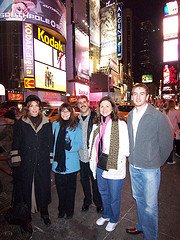
I don't like having my picture taken but when you're hanging with Ben you have little choice. Here we are one night during SES on our way to see "Dirty Rotten Scoundrels". The play was terrific!

From left to right - Chris Churchill, Alice & David Goldstein, me and Ben Pfeiffer.

Besides being a crackerjack photog, Ben also did outstanding job blogging about the conference with Barry, Chris and Lee. Not bad for a bunch of boys ;)

Thursday, March 09, 2006

Nascar Links

If you're reading this because you thought you’d see something on Jeff Gordon or that cute Jimmie Johnson, sorry to disappoint. This is all about fast link acquisition and how to avoid the red flags search engines throw up.

Last week at SES NY, we heard a lot of people ask about link acquisition speeds – or – how many links could they get and stay under the engine’s radar. Most of these questions were asked while discussing link buys but overall, since link building is usually done as a campaign, this could apply to any course of linking.

While there is no stock answer, here are a handful of questions to help you chart a course of action. Start by asking:

How many inbound links do you currently have?
How long did it take you to accumulate the links you have?
Where are they coming from? (industry wise)
Where do they point? What’s the ratio between the dot com and internal pages?
Has your content increased since the domain was launched?
Has your traffic increased as well?
What anchors are being used? What’s the ratio between the dot com and keyword anchors?

Look for patterns in your answers. Could be you notice most of your inbound links use your dot com and point to the home page. To suddenly add links pointing to internal pages and using keyword rich anchors could cause red flags. Or, if you've been online for two years and have accumulated 25 inbounds during that time, you probably don't want to add 250 new links all at once.


Success usually doesn’t happen overnight in business, linking is no different. Slow and steady wins out in this scenario just like any other! When you start linking, consider these tactics:

Add interesting/buzz/in demand/credible/newsworthy content to your site FIRST and issue a press release announcing its creation. Links will happen naturally as a result and you’ve paved the way for your “other” links to happen. (You can also add social bookmark tags such as del.icio.us and Digg to facilitate natural link growth)

Acquire links from a wide array of sites within your niche and be sure to include a handful of links from the industries that linked to you originally. If you started out getting links from one niche, it makes sense you'll continue to attract links from that area.

If your original links used your dot com, include it as an anchor with the new set. Mix it up, try to keep the ratio of new and old anchors about the same as when the site was launched.


Write your new anchors with a strong call to action; it’s important to try and draw as much traffic through the links as possible.

In my experience, larger content rich sites and/or older domains tend to be less prone to ranking shifts when large numbers of new links are introduced. It’s why most content generation tactics are currently working in today’s SEO landscape. Market your links to complement your site, just don’t have them added. If you do, you’ll leave your competition in the dust!

Saturday, March 04, 2006

Blogging 101

Anyone who knows me knows I'm not a technically gifted individual. When people start to talk the "301 this" or "side server that" my eyes glaze over and I drift off into dreamland. It's not that I don't understand any of it, I just don't find it interesting so I don't listen. I'm a firm believer in letting professionals do their job so when I need help with a link marketing project that has something technical involved, I holler out to technical friends. Helps them, helps the client, keeps me out of dreamland.

Usually when I attend SES I find myself drifting away in the "organic" sessions I attend, not because the speakers aren't compelling (they are) but because organic sessions typically touch on technical topics. Not so this time ( well except for the linking clinic but that was different and I actually learned something this time, thanks Greg).

All I heard about was blogging and wiki's. From my perspective (strictly speaking mainstream links) wiki's aren't viable yet but the blogging community..... well....... it's all about blogging these days.

When it comes to linking, blogging offers the full package. Generous outreach. Topically relevant sources. High volume visitation. Fresh content. Credible sources. What's not to like about blogging?

Well, nothing. Which is why you should have one if you're a mid-size to large company doing business on the Web. And how do you learn about blogging? Pop over to
Darren Rowse's site and read all about it. I am and I'm learnin' a ton!!